Operation Crosstalk — Colorado/Wyoming ARES NVIS exercise, May 9 2026
Operation
Crosstalk
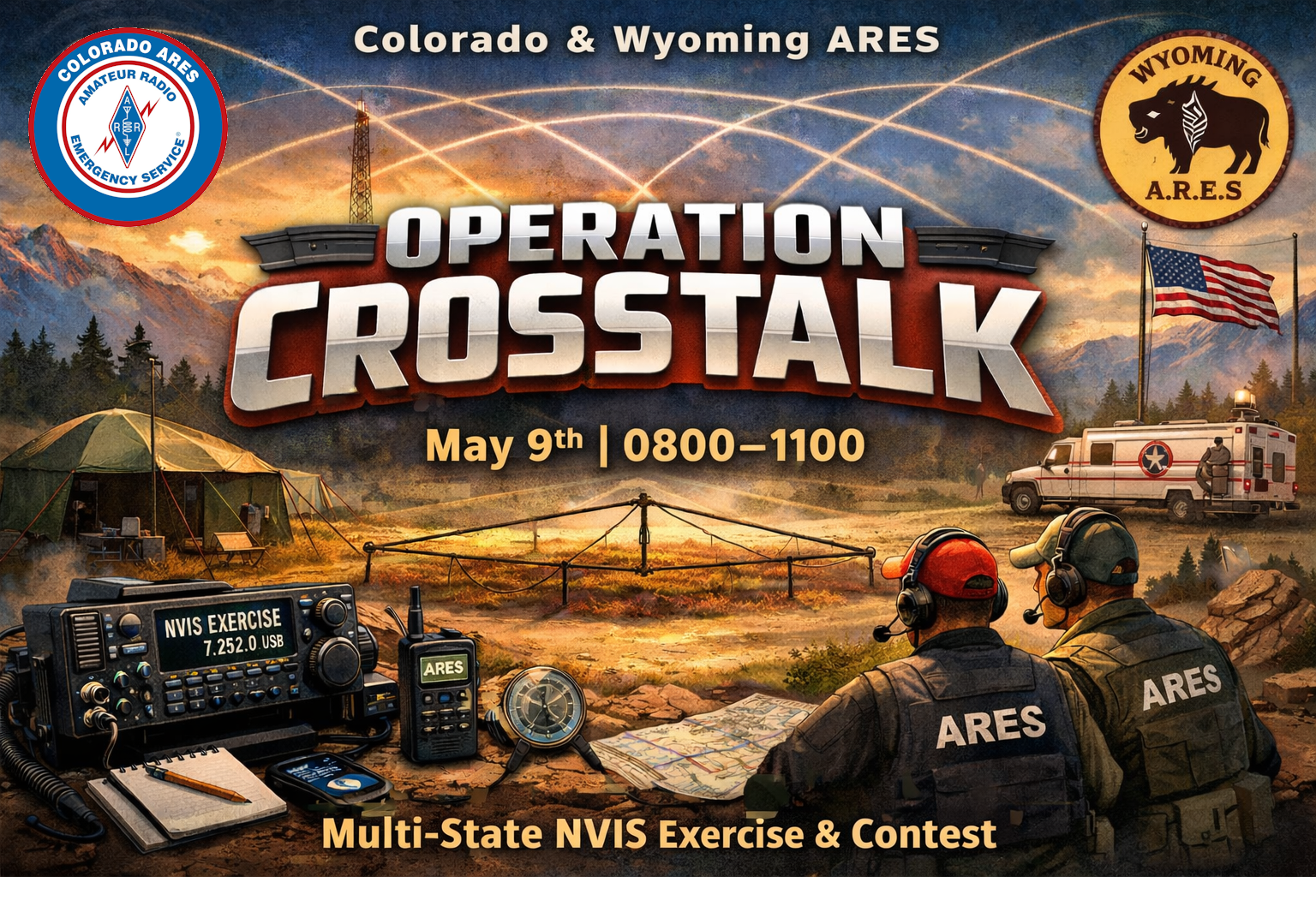
New for 2026, Operation Crosstalk is a three-hour long all NVIS exercise that encourages ARES members to get on the air and make as many NVIS contacts as possible using a defined set of exercise HF frequencies. This exercise is being conducted in cooperation with Wyoming ARES providing even more NVIS possible contacts.
What is NVIS?
Near Vertical Incidence Skywave (NVIS) propagation sends RF energy nearly straight up, where it refracts off the ionosphere and comes back down across a radius of roughly 0–500 miles. It’s the propagation mode that fills the gap between local VHF/UHF and long-haul HF — exactly the range that matters most during a regional emergency. Operation Crosstalk is designed to stress-test our ability to exploit that mode under realistic, time-pressured conditions.
The exercise
The objective is simple: make as many NVIS contacts as possible during the three-hour window. Operators can work individually or as a group, from a fixed location, a portable setup, or from an EOC. Every contact counts — and the exercise is also a contest, so score matters.
Why this matters
NVIS is a foundational emergency communications capability. When infrastructure fails and VHF/UHF repeaters go down, a well-configured HF NVIS station can sustain communications across an entire county or region. Operation Crosstalk gives every participant a low-stakes environment to develop antenna intuition, practice grid square exchange procedures, and build cross-state working relationships with ARES operators in multiple states before those skills are needed under pressure.
The contest format adds an element of fun — this kind of practice directly translates to real scenarios.
How do you Participate?
- Operate portable or from a fixed station during the event times on 40, 60, and 80 meters. All contacts must be regional between 0-500 miles.
- Using an NVIS optimized antenna, make as many contacts with other stations as possible. Provide a true signal report (57, 45, etc.) and exchange your 6-digit maidenhead grid square.
- Use your favorite logging software. Save all logs in .adi (ADIF) file format.
- Upload your log at the end of NVIS Day to https://coloradoares.org/operation-crosstalk-colorado-wyoming-ares-nvis-exercise-may-9-2026
Certificates
Each log submitted with 20 NVIS contacts or more will receive a .pdf certificate acknowledging successful participation in Operation Crosstalk 2026. An NVIS contact is defined as a contact between two stations that are more than 50 miles apart but are less than 500 miles from each other. A separate .pdf certificate will be awarded to the station submitting a log with the highest scored point value.
Frequencies and Radio Operations
The primary operating mode is single sideband (SSB).
Transmit power is limited to 150w or less. 60 meter operation is limited to 100w ERP.
Exercise frequencies are based on the SSB frequencies listed in the ICS-217a forms for CO and WY ARES.
All frequencies are +/- 10 KHz.
| 80 Meters (MHz) | 60 Meters (MHz) | 40 Meters (MHz) |
|---|---|---|
| 3.810.0 | 5.371.5 (Ch 3) * | 7.235.0 |
| 3.923.5 | 5.403.5 (Ch 4) * | 7.240.0 |
| 3.933.5 | 7.260.0 |
Points
Contacts logged 0 to 50 miles from your station are equal to 1 point.
Contacts logged from 50 to 500 miles from your station are equal to 2 points.
Contacts logged with stations 500 or more miles from your station are equal to 0 points.
Bonus Points
Operate within 1000 feet of a city or county EOC for a 1 point bonus per contact.
Optional: Send a Winlink message to WY7AA via the WY7EOC-10 Winlink Post Office.
Winlink Post Office ID = WY7EOC-10 (Located in Cheyenne)
40m = 7.080.0 MHz
80m = 3.583.0 MHz
Logging
To submit a log, upload an ADIF file from your favorite logging software to:
Operation Crosstalk Log Submission
A useful and free tool called ADIF Master is available for download at dxshell.com/adif-master.html. With ADIF Master you are able to edit and correct your ADIF logs.
If you do not have logging software to provide an ADIF log, you can find a logging form at:
https://docs.google.com/spreadsheets/d/1myWJYKwWi-NPryRBO_bsEu1t90hf1bu_/edit?usp=sharing&ouid=100521912522375443436&rtpof=true&sd=true
An Excel file or paper log (take a picture with your phone) can be submitted by email to wyoming.ares@gmail.com.
In your log, provide the following information:
- Your callsign used for the event
- Your 6-digit maidenhead grid square. Look up you grid square at https://zone-check.eu/
- Your radio model
- Your power output
- Your antenna setup including:
- Antenna type (dipole, inverted V, EFHW, vertical, etc.)
- Any key dimensions (height above ground, element lengths, etc.)
- Notable features, obstructions, limitations, outside noise elements, etc.
- Be as detailed as possible and include photos if available
- If you use more than one antenna configuration, please create a separate log for each individual antenna
For each contact please provide:
- Callsign of station contacted
- Six-digit Grid Square of station contacted
- Time (MDT) of contact
- Signal Report received from station contacted
- Band used for contact
- Signal Report sent to station contacted
- Mode used for contact (SSB, CW, etc.)
- Any notes specific to the contact (e.g., “portable setup in a park”, “operating from EOC”, “struggled to hear them until I switched to my NVIS antenna”, etc.)
If you can hear a station, but cannot make a contact with them, add them to your log and provide the RX signal report and enter “No Contact” in the Notes section.
Get out and operate and share this event with others. Go out as a solo operator, get together as a group, just get out and experiment with different antenna types (dipole, inverted-V, loop, etc.).
Keep notes and submit your results after the event for the After-Action Report so that we can learn from each other’s field experience.
We welcome any photos taken of your station, your antenna or your group from the event. The AAR will be shared with everyone that submits a log, and we will make the document public.
Direct questions to W6AUN@arrl.net or check the Colorado ARES website at https://coloradoares.org/operation-crosstalk-colorado-wyoming-ares-nvis-exercise-may-9-2026
Most of all, have a safe and good time operating radio and near vertical incidence skywave!